Sex and gender differences in personal injury in France

Elsewhere in this issue, colleagues have set out how a claimant’s sex can influence their claim for damages for personal injury in England and Wales in a variety of ways. The pattern is not unique to this country. In 2017 the European Court of Human Rights delivered a judgment against Portugal in the case of Carvalho Pinto de Sousa Morais for discrimination in the assessment of sexual harm in a clinical negligence claim. A 50-year-old woman had been left incontinent and unable to have sexual relations after a botched gynaecological operation. Portugal’s Supreme Administrative Court reduced her damages, reasoning that sexuality mattered less to a woman of her age who already had two children than it would to someone younger or to a male victim. Strasbourg found that reasoning to be an unlawful stereotype and held Portugal in breach of the right to private life taken together with the prohibition of discrimination.
What is the position in France?
As in England and Wales, the starting point under French law is the principle of full compensation: the victim must be restored, as far as money can do it, to the position they would have been in but for the accident.
Losses are organised using the Dintilhac Nomenclature, a classification that separates pecuniary losses (equivalent to special damages, including medical expenses, loss of earnings, care and assistance) from non-pecuniary losses. Rather than a global award for pain, suffering and loss of amenity, the classification lists a variety of heads of non-pecuniary losses, all attracting a separate award, including:
- temporary functional impairment;
- permanent functional impairment;
- pain and suffering;
- aesthetic damage;
- sexual harm, assessed across three components — morphological, functional, and relational;
- loss of specific leisure activities.
It is against this framework that the French platform Themia, a jurimetrics tool built to mine personal injury case law, analysed more than 3,000 decisions handed down since January 2022. It presented its findings at a webinar in January 2025, highlighting subtle differences between awards made for specific heads of loss according to the sex of the victim. These findings, combined with other studies by medical bodies, legal practitioners and academics, illustrate the issue across several heads of financial and non-financial loss.
Sexual harm
A 2023 study in the Revue de médecine légale, examining 117 reported decisions from 2012 to 2021, found that awards for sexual harm were broadly equivalent between men and women at matching permanent impairment levels. However, there were differences in the way sexual harm was investigated. Female sexual dysfunction, including loss of libido, pain and lubrication difficulties, was less systematically explored by experts than male dysfunction. Psychological distress associated with sexual harm in men was, in turn, less well documented than in women. This matters because something that is not asked about may never find its way into the expert evidence and, ultimately, may not be compensated. The concern is similar to that identified in Carvalho Pinto, but at an earlier stage: assumptions may influence the clinical assessment before the case reaches the court.
Themia’s jurimetrics analysis provided the following figures for sexual harm of ‘moderate’ severity (4/7):

This shows that the average award made by the court was about €1,300 higher for men than for women. The graph also shows that the amount claimed by men, as well as the amount offered by defendants, was higher than in similar cases involving women.
Aesthetic damage
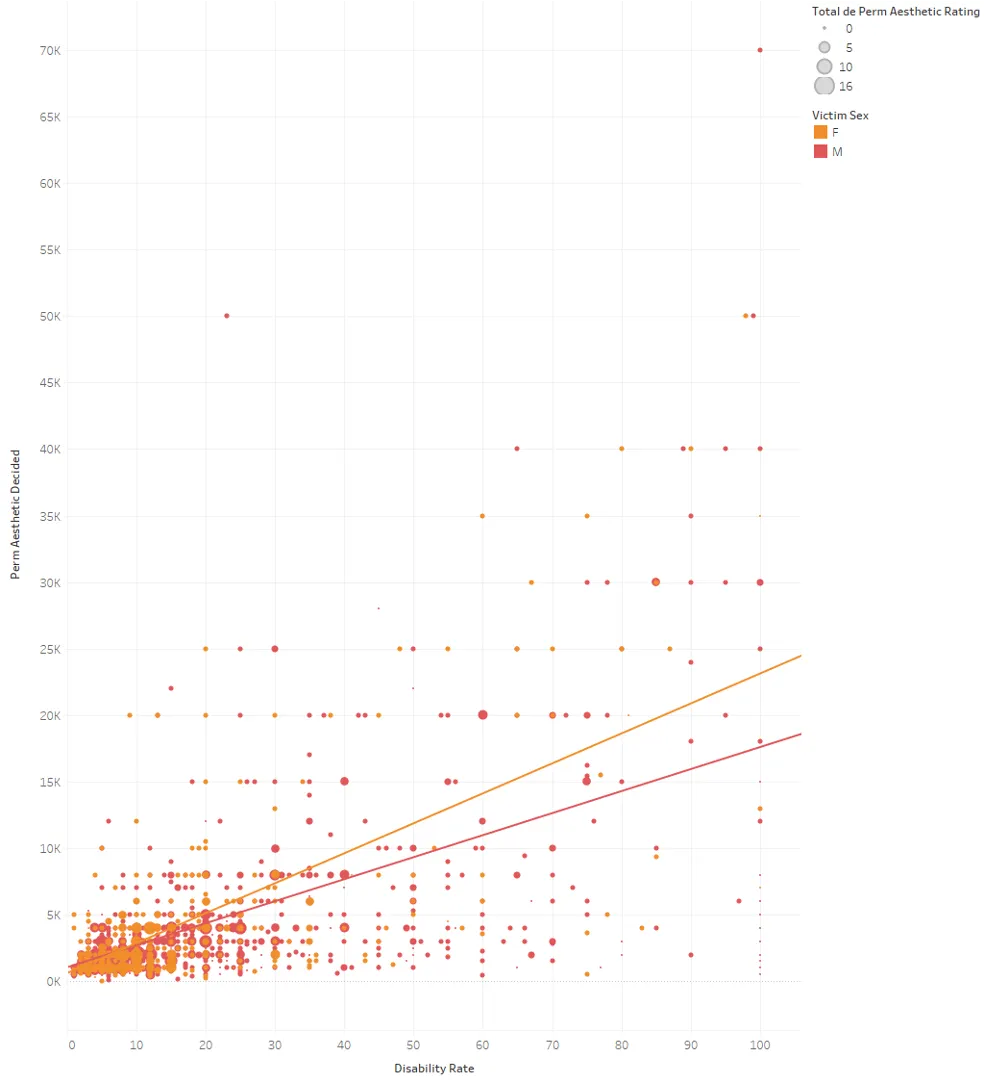
Aesthetic damage runs the other way. At an equivalent rate of global permanent impairment, Themia’s data shows women receiving, on average, slightly higher awards than men, although the difference narrows with age. There is no settled explanation for this. One question is whether visible scarring has a greater impact on women in some cases, or whether the figures reflect assumptions among experts and judges about the importance of appearance to women.
Care claims

French law allows compensation for commercial and gratuitous care in broadly the same way as the law in England and Wales. What Themia's study shows is that women's claims for care and assistance are, on average, lower than men's, despite no objective difference in need being identified between them.
But again, the data shows that the difference was not solely in the award made by the court, but in the claim itself, suggesting that women, or those advising them, ask for less than men — whether through under-recognition of the need, a more general reluctance to assert dependency, or a societal bias against women.
Loss of earnings
In respect of loss of earnings, according to INSEE (French institute of national statistics), women’s average private-sector salary remains around 22% lower than men’s overall, narrowing to roughly 14% for equivalent working time and to a residual 3.6% in strictly comparable posts. Because loss-of-earnings heads inherit whatever wage gap existed before the accident and then project it across decades, the difference in capitalised loss between two victims with identical injuries can run into tens of thousands of euros.
A woman with no paid employment at the time of the accident faces the sharper version of the same problem: her reference income is nil, so her future loss of earnings is technically nil too — only partly offset by the ‘professional impact’ head of loss (incidence professionnelle), which has been used by courts to provide compensation for a stay-at-home mother who lost the prospect of (re-)entering the labour market as a result of her injuries.
Multipliers for future loss
The most widely used capitalisation tables (published by the Gazette du Palais) are sex-differentiated, reflecting women’s longer statistical life expectancy, like the Ogden tables in England and Wales. The aim of differentiating by sex is to enable calculations of the victim’s long-term needs as accurately as possible.
However, this has prompted debate in France. Commentary on the 2022 tables has questioned whether it is appropriate to differentiate by sex, or by sex alone, when education and income affect life expectancy at least as much.
Furthermore, whilst the Gazette du Palais tables are the most widely used, other tables exist and can be used at the court’s discretion in a typical road traffic accident claim. Some specific tables must also be used in specialist injury litigation, such as employment liability claims, which straddle civil law and social security law in France. A procedure similar to a judicial review was brought in the Conseil d’État — France’s highest administrative court — following an employment liability claim, and the Conseil d’État, in 2019, approved as lawful the regulation that had set a multiplier that did not use sex as a variable.
In conclusion
French compensation law, like the law of England and Wales, is neutral as to sex. The differences appear instead to arise from the assumptions that experts, lawyers, courts and the parties themselves may bring to individual claims, usually without conscious intent, about what a victim needs or deserves. Those differences generally disadvantage women, although not always. Awareness of the pattern is the first step towards addressing it. Lawyers acting for personal injury victims have an important role to play by ensuring that every head of loss is investigated thoroughly for each individual client and that assumptions about sex or gender do not influence what is claimed.
Sources
- Carvalho Pinto de Sousa Morais v Portugal, App. no. 17484/15, ECtHR, 25 July 2017 (violation of Article 14 taken with Article 8)
- Themia, “Analyse du genre et de l’indemnisation” (webinar summary, January 2025) https://themia.substack.com/p/retour-sur-le-webinaire-analyse-du
- Joëlle Marteau-Péretié, “Femmes et indemnisation : les inégalités cachées du préjudice corporel,” JMP Avocat (May 2026) https://jmp-avocat-indemnisation.fr/blog-dommages-corporels/femmes-inegalites-indemnisation-prejudice-corporel
- ICREJ, Université de Caen Normandie, “Genre, sexualité et indemnisation du dommage corporel : regards croisés entre théorie et pratique” (colloquium report, June 2025): https://icrej.unicaen.fr/genre-sexualite-et-indemnisation-du-dommage-corporel-regards-croises-entre-theorie-et-pratique/
- Study on gendered evaluation of sexual harm, Revue de médecine légale (ScienceDirect, 2023)
All charts reproduced with Themia’s kind permission.
If you have been injured whilst in France, and think you may have a claim for compensation, contact our specialist injury solicitors.
Call now
More insights from our personal injury experts.





View more articles related to Injury and Team Around the Client