How early rehabilitation helped a motorcyclist rebuild his independence after limb-threatening injuries

Louise Hart explains how early rehabilitation and coordinated support helped a motorcyclist rebuild his independence after suffering devastating injuries in a motorcycle accident caused by unsecured ramps on a passing recovery vehicle.
My client was taking his advanced motorcycle test when ramps being carried by an approaching recovery truck swung into his path, striking his right leg.
The injuries were devastating and threatened the survival of his limb. What followed were several operations, a serious infection and months of rehabilitation. When he first returned home, he was sleeping in a hospital bed on the ground floor and relying heavily on his family.
By the time his claim concluded, he had returned to work, no longer needed a wheelchair and had made significant progress.
A major part of our work was making sure that the right rehabilitation and support were put in place around him while the legal claim progressed.
A devastating leg injury
The accident happened in October 2022. Emergency services attended and Wiltshire and Bath Air Ambulance Charity was dispatched, although the aircraft was unable to land sufficiently close to the scene.
My client was taken by road ambulance to Southmead Hospital with a limb-threatening injury.
He had suffered an open fracture of the lower part of his right femur, a severely comminuted fracture of his kneecap and open fractures of his tibia and fibula.
He underwent surgery on three occasions in the days following the accident. Metalwork was inserted into his femur, tibia and fibula, and the severity of the damage around his knee required further reconstructive treatment. He also needed a skin graft, which was taken from his left thigh.
After extensive surgery, he was eventually discharged home.
Unfortunately, he then developed an infection, requiring his readmission to hospital. The wound required a further washout, and he spent another ten days receiving intravenous antibiotics before returning home with a PICC line still in place.
Back at home, his independence was severely restricted. He was living and sleeping in a hospital bed in the open-plan ground-floor area of his home and needed significant help from his family.
Putting rehabilitation in place early
In a serious injury claim, we want appropriate rehabilitation to begin as early as possible. Treatment was arranged under the Rehabilitation Code, and a case manager was appointed to coordinate my client’s needs.
In appropriate cases, interim payments can also help fund rehabilitation and other needs before a claim concludes.
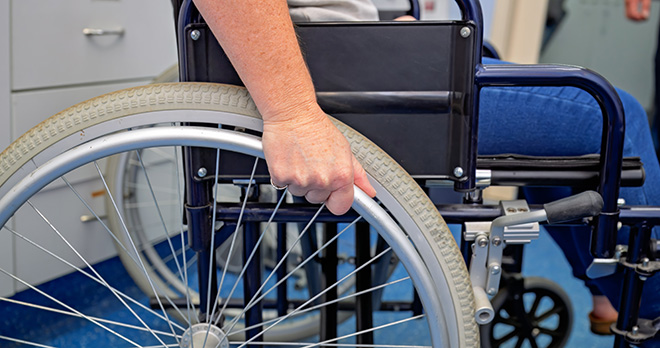
That led to an extensive programme of support, including wheelchair and mobility scooter hire, physiotherapy, occupational therapy, hydrotherapy and work with a personal trainer.
This is where our Team Around the Client approach becomes particularly important.
My role as a solicitor was only one part of the picture. The priority was to make sure my client had the right professionals around him to help with the practical consequences of his injuries and to give him the best possible opportunity to recover as much mobility and independence as possible.
Over time, that approach made a real difference.
He progressed from needing a wheelchair and mobility scooter to walking independently, although he still occasionally uses a walking stick and remains limited in how far he can walk and how long he can stand.
Living with the long-term effects
Although my client made substantial progress, his injuries have left significant long-term consequences.
He continues to experience swelling in his right leg, managed with compression. Movement in his knee is reduced, and his ankle also lacks a normal range of movement. The donor site on his left thigh has been left with altered sensation.
There was a psychological impact too. Following the accident, he experienced post-traumatic stress symptoms at a level consistent with an adjustment disorder.
The effects extended into his working and personal life.
He was unable to work for three months before beginning a phased return. Even then, fatigue meant that he could not work at the same level as before the accident.
Activities he had previously enjoyed also became more difficult. Golf was affected and, by the time the claim concluded, he had not returned to riding a motorcycle.
These are the consequences that matter when we are assessing a serious injury claim. The medical diagnosis is important, but so too are the prognosis and the effect the injury has had – and continues to have – on somebody’s day-to-day life.
Planning for what may happen in the future
The medical evidence showed that my client’s recovery had plateaued.
The orthopaedic surgeon we instructed considered that my client’s symptoms were likely to remain broadly at their present level for between five and ten years. After that, his function was expected to deteriorate and he would ultimately require a knee replacement.
Even following knee replacement surgery, he was unlikely ever to regain full or normal function in his knee.
There was also an assessed overall 1% lifetime risk that his injuries could ultimately result in amputation. A claim for provisional damages was made based on that risk.
This is one reason why serious injury claims can take time to resolve properly. It is not enough simply to consider how somebody is coping at the date of settlement. It is just as important to consider the medical evidence about what may happen in the future and ensure that any properly recoverable future financial losses are taken into account.
Giving something back to the air ambulance
The case also had a more unusual aspect that was particularly important to my client.
Wiltshire and Bath Air Ambulance had been dispatched to help him after the accident but had been unable to land nearby. Although its crew ultimately could not transport him, the charity incurred costs in responding to the emergency.
As part of resolving the claim, the other party agreed to reimburse those costs.
The charity was not automatically entitled to recover this through the personal injury claim. It was an agreed payment.
My client was delighted that this amazing charity, which had tried to assist him on the day of the accident, was able to recover the expense of doing so.
Looking beyond the settlement
The claim concluded in August 2025 with an agreed high six figure settlement, reflecting the seriousness of my client’s injuries, the losses he had suffered and the evidence about his future.
However, the outcome of a serious injury claim cannot sensibly be judged by the final figure alone.
For me, one of the most important aspects of this case was my client’s progress during the claim. He went from sleeping in a hospital bed on the ground floor of his home and relying on a wheelchair to returning to work and regaining a significant degree of independence.
He still lives with substantial restrictions and faces further deterioration and surgery. Nothing about the settlement changes that.
What the legal process could do was help ensure that he had access to rehabilitation when he needed it, bring the right professionals around him and make proper provision for the long-term consequences of his injuries.
If you have suffered avoidable harm, our specialist personal injury team is here to help.
Ask us a question