Biology -V- Birth Certificate

Keeley Lengthorn, partner and head of Public Law Children at RWK Goodman as well as the National Childcare Council representative for the Law Society represented the mother in the recently handed down judgment of Re J, Re M and Re P, a linked appeal involving three cases.
Background
Owing to the complexities of this case and the set of joined appeals, the Court permitted the Secretary of State, Reunited, the Association of Lawyers for Children (the ALC), and the Registrar General to intervene within the proceedings.
There were some 40 solicitors, junior barristers and King’s Counsel involved in this landmark decision.
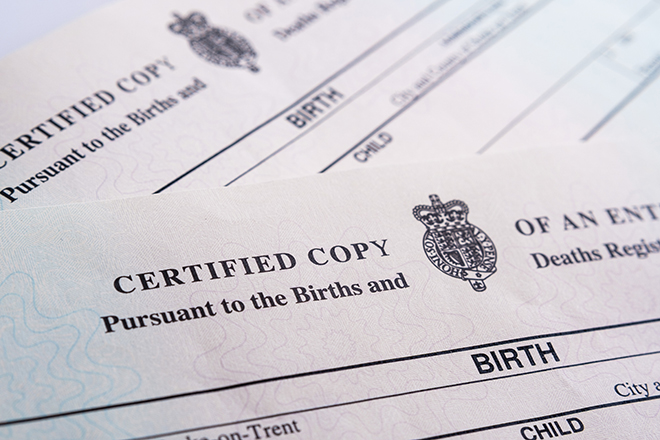
All three matters in front of the court focused on the specific requirements for parental responsibility, and whether it is acquired by registration on a child’s birth certificate.
In Re J there had been a genuinely held belief by both parties at the time the child’s birth was registered that the man named as father on the birth certificate was the biological father of the child. It later transpired that he was not. The issue then became whether he had, at any time, had parental responsibility for the child or could acquire the same.
In Re M, the parties had always known that the individual named as “father” on the birth certificate was not the biological father.
In Re P, this involved identical twin fathers and it was not possible to determine which of them was the biological father and therefore the issue was whether either of them should be named on the birth certificate.
The Key Issues Considered
The appellant fathers in both Re J and Re M argued that registration as “father” under Section 4(1)(a) of the Children Act 1989 should itself trigger parental responsibility, even if it is later proved that this was a mistake. Both appellant fathers relied on Article 8 of the European Convention on Human Rights, contending that Parliament must have intended a practical and accessible route to parental responsibility that did not depend on genetic certainty.
The Court endorsed the position advanced by the Secretary of State for Justice (who was an intervenor) that the statutory language must be read consistently with the common law. Only a genetic/biological father can qualify as a “father” for the purposes of parental responsibility.
The Court also rejected the argument that parental responsibility once assumed, continued unless removed by a Court order. In the simplest terms, if the individual named is not the father, they never had parental responsibility in the first place.
Court’s Decision
In summary, the Court of Appeal has determined that:
1. Parental responsibility was never acquired by the individual who was wrongly named on the birth certificate as the “father”, regardless of any belief at the time of registration;
2. Parental responsibility acquired by being named on a birth certificate only “attaches” to the man named if they are the biological father.
3. The Court of Appeal determined that the definition of a “father” is the common law definition under the Children Act 1989 and relates to a biological father and does not include psychological or social parents.
The Court of Appeal clarified that it is only possible to obtain parental responsibility by being named on a child’s birth certificate if you are the child’s biological or genetic father. Registration alone does not confer legal parentage or parental responsibility where the issue of biology is missing. This means any man/individual wrongly registered as a father on a child’s birth certificate does not acquire parental responsibility at all, rather than losing it at a later stage. He never had it in the first place.
Given that the common law definition of father we now know applies, it is confirmed that there must be genetic certainty. The starting point for any case therefore, where paternity is in doubt, is for there to be a DNA test to determine who is the biological/genetic father.
Sir Andrew McFarlane, in his judgment, made it clear that in order for parental responsibility to be acquired by registration, two conditions must each be fulfilled:
1. The person must be the genetic father;
2. That person must be registered as the father.
Where that first condition is not met, no parental responsibility is acquired at any stage.
This judgment also raised issue about a potential lacuna in the law in terms of abductions under the 1980 Hague Convention. Where a registered father is later shown not to be the biological father, he may never have had rights of custody, meaning a removal or retention of the child may not be a wrongful removal under the Convention. Protective orders may therefore be appropriate.
After years of uncertainty with conflicting judgments at first instance, the Court of Appeal has now confirmed that parental responsibility under Section 4 of the Children Act is dependent on biology and nothing else. Social or psychological parenting shall not be a consideration.
If in doubt about paternity at any stage where there is an unmarried father on a child’s birth certificate, the starting point must always be a DNA test.
The full Judgment can be read here:- Re J, M-S-K-B & P [2026] EWCA Civ 344 | 1GC|Family Law
Talk to us today and we can help
At RWK Goodman, our Family Team advises and represents parents and guardians in complex applications concerning children under the Children Act 1989.
Where there is a serious disagreement about a child’s medical treatment, including cases involving life-sustaining care, we guide families through specific issue applications and urgent High Court proceedings with clarity and sensitivity. We ensure that our clients understand how the court approaches welfare and “best interests” decisions, and we work closely with a select group of specialist Counsel to make sure parents’ voices are properly heard.
Keeley Lengthorn is a specialist in complex children cases, including disputes relating to serious medical treatment. Her experience in handling sensitive and high-stakes applications under the Children Act 1989 means families receive both strategic legal advice and compassionate support during what is often an incredibly distressing time.
Other relevant services



Read more from around RWK Goodman








View more articles related to Children Disputes, Family, Family Dispute Resolution and Injunctions and Emergency Remedies