Recovering hospice costs when bringing a negligence claim

In this article, Jennifer Seavor, Partner in our Respiratory Diseases team, takes us through the specific and unique circumstances of recovering the cost of hospice care when bringing a clinical negligence claim. For information on the other types of compensation that can be claimed in a negligence claim after someone has died, please see our article here.
Many of our clients with life limiting illnesses such as mesothelioma, lung cancer and silicosis caused by the negligent exposure to asbestos or silica dust, often during their employment, will ultimately require support with pain management, symptom control and well-being as their conditions progress, and eventually professional palliative and end of life care.
Many of our clients are supported by hospices, but some do not realise that hospices are not part of the NHS. Most rely predominately on charitable donations to provide the services they do, as well as central funding. This means the patient does not have to pay for the care provided to them.
Historically, the costs incurred by hospices in supporting and caring for patients were not recoverable when the patient was pursuing a claim for compensation if their condition was caused by the breach of law or negligence of another person, company or organisation. However, the landmark case of Drake v Foster Wheeler Limited [2010] EWHC 2004 saw a fundamental change meaning that when hospice care is provided, the charitable proportion of the costs incurred can be recovered in a legal claim, from the opponent.
The case that brought about the change – Drake v Foster Wheeler Limited
The Claimant in this case was diagnosed with mesothelioma and his health deteriorated to such an extent that he required round the clock care and assistance. This was provided gratuitously by his two daughters however as he sadly approached the end of his life he needed professional input. He was admitted to St Joseph’s Hospice for 23 days in the run up to his death. At that time 62% of the hospice’s running costs came from charitable donations – funding which the hospice had to generate themselves to provide care and support to the Claimant at no cost.
The question in law arose whether a Defendant should be liable to pay damages to a third party for their charitable provision of services. The Claimant’s argument was that this was no different than a claim for care by family members and should be recoverable and paid to the hospice. The Defendant contended that care was not provided or charged for under a contract, and as there was no legislative requirement to reimburse the hospice, there was no obligation for them to do so, nor was there precedent on the matter.
The Claimant succeeded on the point and recovered in full the funding that had come from charitable donations meaning St. Joseph’s Hospice received over £10,000 from the claim.
What evidence is needed when bringing a claim for hospice care?
In order to recover hospice costs, a Claimant will need to confirm the full costs incurred by the hospice in providing care and support services, as well as confirmation of the percentage of their overall annual funding which comes from charitable sources, as it is only that element which can be recovered.
Since this decision, it has been a matter of routine that we are able to successfully recover the charitable proportion of hospice funding within claims, giving hospices a much-needed financial boost to continue providing the wonderful services they do.
Helping out St Joseph’s Hospice
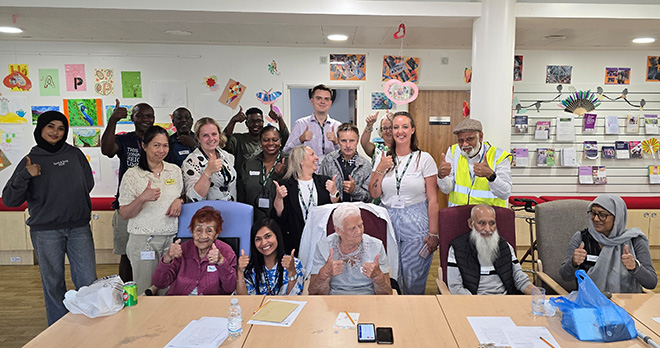
Last year, members of our London Respiratory Disease team had the opportunity to spend the day volunteering at St. Joseph’s Hospice in Hackney. Their ‘mission’ is to provide compassionate, specialist palliative care to people in the diverse community of East London who are living with life-limiting illness. Like most hospices, St Joseph’s Hospice care is provided free of charge to those who need it.
They aim to treat each person as unique, encouraging and enabling them to reach their full potential until the end of their life. Hospice care is about living well with debilitating and life limiting conditions for as long as possible, not just about the end of life. They listen to the patient and their family so that they can work together to manage pain and distress whether physical, mental, social or spiritual. Whilst St Joseph’s receive some NHS statutory funded income, they primarily rely on charitable donations to carry out their work.
Our team, along with representatives from charity HASAG (also mentioned in this edition), volunteered at St Joseph’s Day Hospice and all took part in crafting activities with the patients, spending time chatting and learning more about their lives and experiences and the difference hospice support had made to them. We also hosted a quiz for the patients and played a few rounds of bingo. We were honoured to be given a tour of the Hospice which was really insightful and showed us first hand the difference hospice support and care can make to people who are faced with the devastating diagnosis of a condition which will sadly lead to their death.
We received the following feedback from Zenab Ali, the Day Hospice Manager, following our visit to St Joseph’s:
“We are so grateful for your time, energy, and warmth — your presence truly made a difference. The postcard activity was a great success, and the patients were genuinely moved by the opportunity to write heartfelt messages to their loved ones. Your team helped create such a joyful and comforting atmosphere, and your kindness did not go unnoticed.”
The future
Many of our clients receive hospice care, both at home and as inpatients, so we know first-hand the impact that hospices can have on a client and their families. As part of legal claims, we can claim back the non-NHS funded care provided to our clients and we see it as an imperative part of our work.
We know how difficult it is for hospices to meet their fundraising targets each year, with some needing to fundraise as much as 70-80% of their income, amounting to millions of pounds. We are so pleased that we can help our clients give something back by recovering hospice costs which will enable hospices to reach a greater number of people in need.
The service hospices provide undoubtedly reduces the burden on the NHS and this has been recognised in law. However, the question remains whether other charitable organisations should be able to recover the charitable proportion of their costs for services that they provide to Claimants.
It is easy to see how the principle established in Drake could be expanded to take into consideration the wide-ranging support that some Claimants with life limiting illnesses receive from a variety of charitable organisations and this is something we are alert to for our clients in the claims we pursue for them.
Contact Jennifer.

Our inquests and fatal claims expertise.


More articles from our Team Around the Client Series and Inquests and Fatal Claims.









View more articles related to Inquests and Fatal Claims and Team Around the Client