Silica dust on construction sites: why everyday work can put your lungs at risk

Silica dust remains a serious occupational hazard across the construction industry, although the risks aren't always obvious. Jennifer Seavor looks at how workers can be exposed, the potentially serious consequences for their health and why greater awareness matters.
If you’ve worked on a building site, you’ll know how quickly cutting a paving slab or grinding out mortar can fill the air with dust. Once the cloud has cleared, it’s tempting to think the problem has gone with it.
Unfortunately, some of the most dangerous particles are too small to see.
I’ve written before about the worrying rise in silicosis linked to engineered stone, particularly among people making and fitting kitchen worktops. Some have developed the disease at a surprisingly young age.
But the danger isn’t confined to engineered stone. Construction workers have been exposed to silica dust for generations, often while carrying out jobs most people wouldn’t think twice about.
Which construction jobs create silica dust?
Silica is found naturally in stone, sand and clay, and in everyday building materials such as bricks, concrete and mortar.
When these materials are cut, drilled, ground or broken up, they can release very fine particles known as respirable crystalline silica (RCS). These can be breathed deep into the lungs, where they may cause permanent damage.
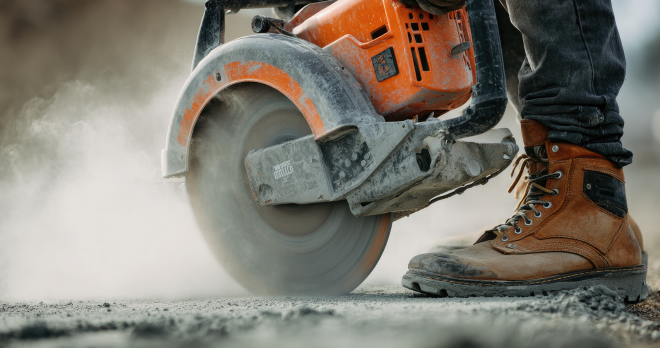
Think about the jobs carried out on construction sites every day. Cutting concrete slabs or kerbstones. Chasing walls to install electrical cables. Grinding out old mortar before repointing brickwork. Drilling into concrete or demolishing masonry.
All can produce harmful silica dust.
And it isn’t just the person operating the equipment who may be exposed. Other workers nearby can breathe in the same dust, particularly in enclosed spaces.
Even sweeping up afterwards can create another cloud of fine particles.
The Health and Safety Executive (HSE) estimates that more than 500 people who have worked in construction die each year from silica dust exposure. That includes other lung illnesses like lung cancer and COPD, not just silicosis.
Isn't working outdoors safer?
Not necessarily.
It’s easy to assume that dust created outdoors will simply blow away. But someone using a saw or grinder is often working right beside the source and can breathe in heavy dust before the wind disperses it. What you can see isn’t a reliable guide to risk either, as fine respirable dust often goes unnoticed.
The risk depends on the material, the equipment being used, the length and frequency of exposure, and the precautions taken.
Someone occasionally cutting paving slabs and someone spending every working day grinding concrete won’t necessarily face the same level of risk. But both jobs need appropriate precautions.
What protection should construction workers expect?
The starting point should be preventing or reducing the dust, rather than simply handing someone a mask.
Under the Control of Substances Hazardous to Health (COSHH) Regulations 2002, employers must assess the risks from hazardous dust and take appropriate steps to control exposure.
Sometimes that means changing how a job is done. Could materials be supplied already cut to size? Could a block splitter be used instead of a powered saw? Is there another way to complete the work without creating so much dust?
Where dusty work cannot be avoided, suitable water suppression or on-tool extraction can make an enormous difference.
But these precautions have to be used properly. Wetting the ground before cutting isn’t the same as supplying enough water throughout the job. Extraction equipment must also be suitable for the task and properly maintained.
Even with other precautions in place, workers may still need to wear a mask. For higher-risk work involving silica dust, the HSE generally recommends an FFP3 mask or a half-mask respirator with a P3 filter. Both offer an assigned protection factor of 20 when properly fitted. Tight-fitting masks must also be face-fit tested.
An ordinary, non-rated dust mask won’t provide adequate protection. And even a properly fitted respirator won’t stop dust spreading to other workers nearby. The HSE’s guidance on chasing concrete and raking mortar sets out the controls expected for two particularly dusty tasks.
What if you worked with silica dust years ago?
Silicosis can take many years to develop. The disease causes inflammation and scarring in the lungs, and symptoms can include a persistent cough, breathlessness and unusual tiredness.
Particularly heavy exposure can cause illness much sooner.
For someone who has spent their working life in construction, it can be difficult to connect breathing problems today with jobs carried out decades ago.
Of course, not every cough or episode of breathlessness means someone has silicosis. There are many possible causes.
Nevertheless, if you’ve worked regularly with concrete, bricks, stone or other silica-containing materials, it’s important to tell your GP about that history, particularly if you’re experiencing respiratory symptoms.
The NHS guidance on silicosis explains how the condition is diagnosed and treated.
There is currently no cure for the lung scarring caused by silicosis, although treatment can help manage symptoms and improve quality of life.
What if you're still working with silica dust?
If you’re regularly involved in dusty construction work, it’s reasonable to ask what is being done to protect you.
Has the risk from silica dust been assessed? Are suitable extraction or water suppression systems available? Is respiratory protection appropriate for the work, and have you been shown how to use it correctly?
Where workers are regularly exposed to silica dust and there is a reasonable likelihood that they could develop silicosis, employers must arrange health surveillance. This can include lung function checks. I’ve written separately about silicosis and workplace health surveillance, including when health checks are required and what they should involve.
If you’re concerned about working conditions, raise it with your employer, supervisor or safety representative, or contact the HSE. Don’t wait for a routine check-up if you notice a persistent cough or unusual breathlessness; get checked out promptly by your GP.
When the damage has already been done
For someone diagnosed with silicosis, discovering that their illness may have been caused by work carried out years earlier can come as a terrible shock.
There may be worries about continuing to work, supporting a family and what the future holds.
Where inadequate workplace precautions contributed to the illness, there may be grounds for a compensation claim. Our specialist Respiratory Disease team can investigate what happened and advise on silicosis compensation claims, including cases involving exposure many years ago.
I’d much rather see fewer people needing our help in the first place.
The dangers of silica dust have been known for decades, and so have the precautions needed to protect workers. What matters is whether those precautions are actually taken, even for the most routine jobs.
Our specialist team can help you find out whether more should have been done to protect you and advise you about a possible compensation claim. The call is free and there’s no obligation.
Ask us a question