‘Worrying’ increase in patient admissions for unintended cuts during medical care

Data from the NHS indicates a 65% rise in patients being admitted to hospitals for unintended cuts or punctures during surgical and medical care over the last five years.
The data
How often are people admitted for unintentional cuts in medical or surgical care, or having had something left inside them?
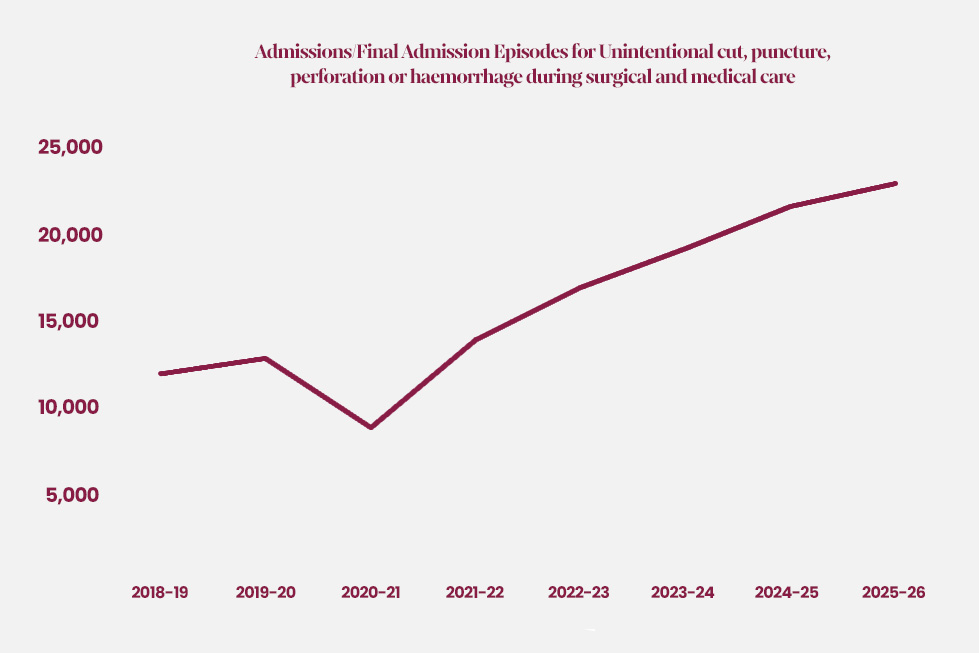
Analysis we’ve done shows that, according to NHS England data, there were 22,914 admission episodes during the 2025-26 year which listed ‘Unintentional cut, puncture, perforation or haemorrhage during surgical and medical care’ as an external cause of a patient’s submission, the highest figure since tracking began in 2012-13.
Since 2021-22, there has been an increase of 8,993 admission episodes tagged under the cause, while other causes relating to complications stemming from surgical and medical care have also seen overall increases in admissions.
External causes relating to a ‘Foreign object accidentally left in body during surgical and medical care’ has seen a 57% increase in the same time period – however this number is significantly smaller at just 356 admissions recorded for the 2025-26 year and down from 404 recorded in the previous period.
In the most recent year of data reporting, the vast majority of admissions relating to unintended cuts and punctures during surgical and medical care were through waiting lists, with 18,373 admissions and an average waiting time of 96.2 days and a stay time of 8.1 days. There were also 2,932 emergency admissions during 2025-26, an increase of 200 from the previous year and an overall 42% increase from 2021-22.
The full data table
Covering admissions or finished admission episodes per year, as terminology changes.
| External cause for admission | 2018-19 | 2019-20 | 2020-21 | 2021-22 | 2022-23 | 2023-24 | 2024-25 | 2025-26 |
| Unintentional cut, puncture, perforation or haemorrhage during surgical and medical care | 11,929 | 12,836 | 8,822 | 13,921 | 16,928 | 19,174 | 21,630 | 22,914 |
| YoY change | n/a | 8% | -31% | 58% | 22% | 13% | 13% | 6% |
| Foreign object accidentally left in body during surgical and medical care | 210 | 213 | 179 | 227 | 274 | 335 | 404 | 356 |
| YoY change | n/a | 1% | -16% | 27% | 21% | 22% | 21% | -12% |
Our expert's reaction
What does this data mean?
Simon Elliman, head of our clinical negligence team, says:
“While these are undoubtedly a small number of cases in comparison to the more than 18.4 million admission episodes the NHS addresses on an annual basis, the bottom line is that this figure should be zero. The worrying upwards trend suggests more clinical errors which can cause significant impact to a patient’s quality of life and recovery are slipping through the cracks of an increasingly-stretched NHS.
“Patients admitted for these types of matters are likely to take up additional bedspace and increase the costs to taxpayers, as hard-working staff need to spend time helping address these follow-up complications as well as contribute to wider potential legal costs for negligence claims which stem from the original incident and additional care.
“There could also be a wider logistical cost as well – while not every one of these admissions could be reasonably seen during initial aftercare, on average the data suggests each admission for an unintended cut or puncture leads to an eight day hospital stay. An extra day of aftercare and support following the initial medical or surgical care where these matters are potentially caught could unlock a huge number of beds for wider healthcare purposes.“
“It’s clear that the NHS is under immense pressure to support patients effectively and with the high-quality care we know they can provide, but this trend suggests further resources and focus on patient safety and aftercare are needed to stop what shouldn’t be a statistic at all from continuing to rise significantly year-on-year.”
About Simon Elliman
Find out more about Simon, head of our medical negligence team, by visiting his profile.

If you or a loved one has been impacted by the issues we’ve raised, or has suffered another injury as a result of negligent hospital care, we’re here to help you find out whether you have a claim for compensation.
Call now