Fatal accident claims – how much compensation might you receive?


When you lose a loved one suddenly in a fatal accident, as well as the devastating sense of loss and grief, you may wonder how you are going to cope with the loss both financially and in day to day life.
The losses suffered by both the deceased's estate and their dependants can be extensive and varied, so here we will take you through the different kinds of compensation you may be able to recover in England & Wales.
Consideration will be given to the losses to the estate brought under the Law Reform (Miscellaneous Provisions) Act 1934 as well as the losses to the deceased’s dependants, to be brought under the Fatal Accidents Act 1976.
A claim brought on behalf of the estate is pursued in the name of the personal representatives of the estate, either Executors (where there was a Will) or Administrators (if there was no Will). Either a Grant of Probate or a Grant of Letters of Administration is required to stand as the authority for the personal representatives to bring a claim for the estate. We go into more detail about who is entitled to bring a claim in our guide to fatal accident claims here.
How compensation is calculated after a fatal accident
There’s a range of different expenses and losses that will be taken into account when calculating the ultimate value of a fatal accident claim. Here we break these down by those which are recoverable based on the deceased’s estate, and those recoverable for their dependants.
Compensation recovered based on deceased’s estate
Funeral and associated expenses
One of the primary recoverable losses on behalf of the estate is the cost associated with the funeral of the deceased.
Funeral expenses can include expenses for the funeral service, burial or cremation fees, and any associated costs such as flowers and transportation. These costs are recoverable under the Fatal Accidents Act 1976 if paid for by the dependants, or under the Law Reform (Miscellaneous Provisions) Act 1934 if paid for by the estate.
The funeral is likely to be a considerable initial expense for the loved ones and so an early interim payment is often sought from the Defendant’s insurer to cover this expense.
Loss of earnings and medical expenses
In the event that your loved one did not pass away immediately following an accident, a claim can be pursued on behalf of the estate for the loss of earnings that the deceased would have earned had they lived, up to the date of death. This includes wages, bonuses, and other forms of income.
If your loved one incurred medical expenses due to the accident prior to their death, these costs are recoverable. These may include medication, rehabilitation costs, and other related expenses such as travel expenses and subsistence expenses incurred by visitors to the hospital, as well as care and assistance provided prior to death.
Loss of or damage to property
In the event of an accident, the vehicle being used by your loved one at the time may have been damaged or written off, and the estate is entitled to claim for the amount of this loss.
In addition, if other items were lost or damaged such as a helmet, clothing, tools in the vehicle or other items not recovered from the scene, then the estate can include these in the claim.
Pain and suffering
The estate also has the right to include a claim for your loved one’s pain and suffering prior to their death. The level of compensation would depend on the individual level of consciousness as well as awareness and severity of the pain, taking account of the length of time they survived after the accident.
This aspect of a claim requires detailed review of medical records and witness evidence to determine the extent of the suffering. Once that evidence has been collated, there is guidance available to determine the level of compensation for pain and suffering, if any, that should be awarded.
Compensation that can be recovered on behalf of dependants
Bereavement award
The qualifying criteria for a bereavement award are not the same as for the claim for loss of dependency (financial or services).
The people who may claim damages for a bereavement award are limited to:
- wife or husband or civil partner of the deceased;
- where the deceased was younger than 18 and never married or never in a civil partnership:
- the deceased’s parents, if the deceased was legitimate; and
- the deceased’s mother, if the deceased was illegitimate.
- The co-habiting partner of the deceased, which means any person who:
- was living with the deceased in the same household immediately before the date of the death; and
- had been living with the deceased in the same household for at least two years before that date; and
- was living during the whole of that period as the wife or husband or civil partner of the deceased.
Where there is a claim for bereavement damages for the benefit of more than one person, the sum awarded will be divided equally between all persons who are eligible. It is therefore important to investigate whether the deceased had divorced, and may have a surviving spouse or civil partner and a cohabiting partner.
Alternatively, the deceased may have been younger than 18 and never been married or a civil partner, but they may have been cohabiting with someone before their death. In these circumstances the bereavement award will need to be divided equally between the people who are eligible.
The amount of the award depends on the date of death, but for death on or after 1 May 2020 it is only £15,120.
Dependants
Dependants can claim for the loss of financial support that their loved one would have provided. The statutory definition of dependant is quite wide and as such, careful consideration is required to identify all possible dependants.
Under the law, only one claim can be brought on behalf of ALL dependants of the deceased, so it is imperative that full consideration is given to all those who were dependent on the deceased, financially or otherwise, at the time of death.
The dependant must also prove that they were or were likely to be a dependant in fact, i.e. that they have lost some sort of dependency as a result of the death.
Under the Fatal Accidents Act 1976, s 1(3) a ‘dependant’ is defined as:
- the wife or husband or former wife or husband of the deceased;
- the civil partner or former civil partner of the deceased;
- any person who:
- was living in the same household immediately before the date of death; and
- had been living with the deceased in the same household for at least two years before that date; and
- was living during the whole of that period as the husband or wife or civil partner of the deceased;
- any parent or other ascendant of the deceased;
- any person who was treated by the deceased as their parent;
- any child or other descendant of the deceased;
- where the deceased was married or in a civil partnership at any time, any person who was treated by the deceased as a child of the family in relation to that marriage;
- any person who is, or is the issue of, a brother, sister, uncle or aunt of the deceased.
Loss of financial support
Where the deceased was working their earnings are crucial to the question of dependency, losses are not limited to pure income. Forms of dependency may include:
- loss of the deceased’s income;
- loss of benefits from deceased’s employment (e.g. company car or accommodation);
- loss of deceased’s pension.
When calculating the dependency based on loss of the deceased’s earnings (or pension), a conventional approach is taken which assumes that the deceased would have provided a proportion of their earnings to their family with a modest proportion of their earnings for their own expenses. The starting point is the conventional deductions:
- 33% is deducted where the only dependant is a spouse or civil partner;
- 25% is deducted where there are dependant children as well as a spouse or civil partner.
The calculation involved finding the aggregate earnings of the deceased and spouse/civil partner, then reducing the aggregate figure by 33% or 25% (where there are dependant children), then deducting the spouse’s/civil partner’s income.
Loss of services
The loss of services provided by your loved one is very broad an commonly includes:
- housework;
- DIY and maintenance;
- decoration;
- childcare;
- gardening;
- dog walking.
Witness evidence will be required to support this part of the claim to set out in detail what your loved one had done in the past, their skills and projects undertaken. Photographs of work carried out in the home or garden would also be of assistance for this head of claim.
Quite often the lost services claim affects a wider class of dependant than those people who were directly financially dependant on the deceased.
Loss of consortium
A further claim supported by a case called Regan v Williamson relates to a claim for the loss of companionship, care, and affection that loved ones would have received from the deceased.
This non-economic damage is often challenging to quantify, and the amount of the award varies considerably. It is unlikely such an award would be made where to the person / people receiving the bereavement award.
How can you prove losses in a fatal accident claim?
As a dependant, in order to prove losses during the process of a fatal accident claim a range of evidence can be used. This may include:
- financial documentation: such as pay slips, tax returns, and bank statements to establish loss of earnings and financial support;
- state pension forecast for the deceased and their spouse;
- private pension forecasts for the deceased and their spouse;
- medical records in relation to the medical treatment received by the deceased before their death and to check their past medical history and whether this could affect normal life expectancy;
- receipts and invoices: proof of expenses related to funeral costs and all expenses incurred;
- statements from family members and friends to substantiate claims for loss of consortium and services.
Calculating the various losses and resulting compensation value requires a detailed approach. It involves gathering comprehensive evidence, including financial records, employment details, medical reports, and statements. Expert witnesses may be called upon to provide accurate valuations and support the claims.
Pension loss calculations can be complex, depending on the age of your loved one, and may require expert analysis. Often greater contributions are made towards the end of the working life and projections of likely pension income should be obtained.
Payments received after death
In accordance with Section 4 of the Fatal Accidents Act 1976, if the dependants or the estate receives certain payments after death then they can be disregarded, even if that results in a double recovery.
If the DWP makes a payment to assist with funeral costs, it is not deducted this from the full claim for this head of loss.
Likewise, if a fundraising page (such as GoFundMe) is set up to assist the loved ones after death, then these funds would not be accountable and a claim for funeral and other expenses can still be made in full.
Quite often, loved ones would have life insurance or are entitled to a death in service payment from employers. These payments are excluded from the claim, and they are not set off or deducted from any claims for loss of financial dependency or otherwise.
Unusual expenses that may form part of a fatal accident claim
There are also less common, but still recoverable expenses, such as:
- financial contributions or gifts the deceased would have provided, usually to family members. It is important to remember that the definition of dependants is quite wide so investigation of all regular gifting and gift patterns must be established. This would be supported by witness evidence of past giving patterns;
- loss of opportunity for tax planning or other financial strategies, such as increasing pension contributions, that were lost due to the death;
- loss of anticipated gifts from the deceased (e.g. a contribution towards the cost of any possible future wedding and/or a first home);
- losses caused by the death (e.g. inheritance tax paid on gifts made less than seven years prior to death).
Compensation for the death of a child
If the deceased is a child under 18 then it is likely that a parent will receive a bereavement award as well as payment of estate losses.
It should also be borne in mind though that, in some cases, investigation is required to ascertain whether that child had been working and contributing to the dependants, or whether they had provided services such as a young carer, or carried out service tasks in the home.
If a child is over 18 then no bereavement award can be made to their parents, but investigation of the family dynamic as regards that person’s contribution (either financially or through services) must be made and consideration given as to how likely it is that they would continue to provide the contribution at the same or an increased level after death.
Many young people cannot afford to leave home at an early age so consideration of the overall position must be made to assess whether there is a reasonable future claim to be pursued.
Find out how we've helped clients in this situation.
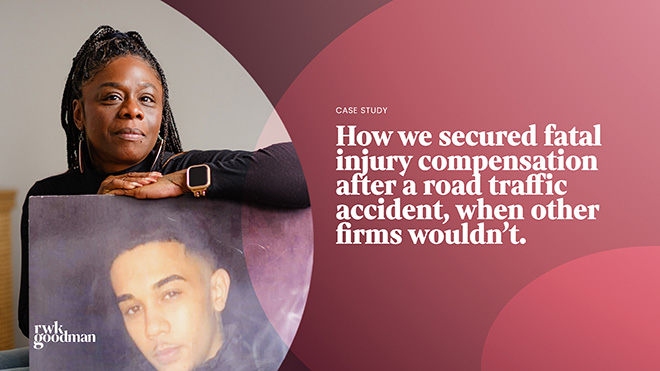
After the death of her son, our client struggled to find legal support to seek compensation as firms were concerned about the low value of the claim and couldn’t see a dependency claim. That’s where we came in.
Fayonne Sandy came to us two years after the death of her son, Zaide, having been referred by the Motor Accident Solicitors Society (MASS). On first consideration, it appeared that she would not be entitled to more than limited compensation due to the fact that her son was only just 19 years old; however, our fatal accidents team helped secure the compensation she deserved.
If you have lost a loved one in a fatal accident, you may find the thought of securing compensation daunting. If that is the case, our expert solicitors are here to help guide you through the process.
If you would like to find out more about securing compensation following a fatal accident, contact our specialist team of solicitors to find out more.
Call now
More services related to fatal accident claims.






Read more insights from our fatal injury claims team.





View more articles related to Inquests and Fatal Claims