£1.2 million secured for delayed diagnosis of cauda equina syndrome

Simon Elliman secured a lump sum of £1,200,000 for a 42-year-old man for an injury sustained in August 2019 following a negligent delay in diagnosis of cauda equina syndrome.
As a result of the claim, it was admitted that – had our client had surgery at an earlier date, with competent treatment – he would not have suffered the injury which caused the cauda equina syndrome he now lives with. As a result of this delay he suffered physical symptoms including impaired bladder function, impaired bowel function, impaired sexual function, reduced sensation in the lower limbs and genital area, altered gait and reduced mobility along with pain in the coccyx area. He also experienced psychiatric damage.
What happened
In August 2019, our client had been experiencing lower back pain for a few weeks, but it did not appear too serious, and he was still able to work. However, on Tuesday 13 August he woke up at four in the morning, or thereabouts, in excruciating pain. Our client lived with his father, and his father called an ambulance two hours later. He was taken to North Middlesex Hospital.
The records demonstrate that he was taken to North Middlesex Hospital via ambulance and was triaged at 7.17am. The triage notes record that he had been suffering for five weeks with lower back pain radiating to his right leg, but today he was complaining of numbness of his right leg and reduced urine output. He had, however, passed urine today.
The following Monday (19 August) our client had a GP appointment, where he was reported to be walking. From the records, it appears that no examinations were carried out and no investigations took place, certainly no record of any ‘red flag’ warnings. He was simply discharged on the basis that follow-up treatment would be provided by his GP.
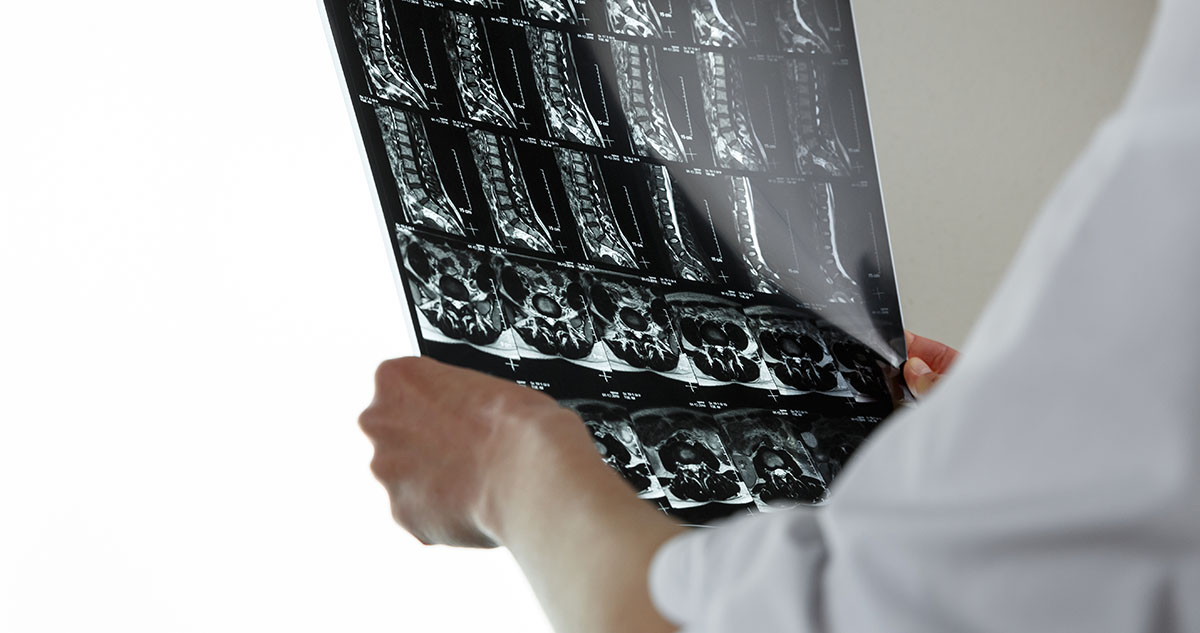
Our client’s condition deteriorated, and he began to develop numbness in the saddle area. By the morning of 15 August, he was in excruciating pain and had very significant numbness in the saddle area. His father contacted his GP, who attended in the early afternoon and diagnosed him with cauda equina syndrome. The GP advised him to attend hospital immediately, so our client again attended North Middlesex Hospital Emergency Department, arriving at shortly after four o’clock in the afternoon, where further investigations were carried out. A decision was taken to perform an urgent MRI scan and then transfer to University College Hospital for urgent decompression surgery. Our client then underwent decompression surgery in the early hours of 16 August 2019.
The impact of cauda equina injury on our client
Despite decompression surgery our client suffers from bladder dysfunction requiring intermittent self-catheterisation. He also suffers from bowel dysfunction and sexual dysfunction.
Furthermore our client has marked sensory change in the L5, S1, S2. S3 and S4 dermatomes, with weakness of L5 bilaterally. He suffers from pain in his coccyx and in his feet/heels. He also suffers with poor balance, an abnormal gait and impaired mobility due to a combination of sensory and motor deficits. As a result of the ordeal and his injuries, he has also developed a mixed depressive and anxiety disorder.
Our client’s physical condition is permanent, and what’s more his mobility will deteriorate with age. He continues to live with his father who performs most of the domestic activities around the home. Our client did not return to work as a filing clerk for the defendant after these events, and is currently unable to work. He will always be handicapped on the labour market and future loss of earnings made up a significant part of the damages.
The defendant, North Middlesex University Hospital NHS Trust admitted that our client should have had an emergency MRI scan and that his should have been discussed with the neurosurgery team and that if he had been treated appropriately he would have undergone decompression surgery on 13 August 2019. However, the Defendant denied that our client would have made a full recovery even with further decompression surgery. It was our client’s case that if he had been treated appropriately he would have had a normal or near normal outcome including:
- normal bowel function;
- normal bladder function – avoiding the need for intermittent self-catheterisation to effect bladder emptying;
- no profound impairment of sacral sensation;
- normal sexual sensation;
- no heel/foot pain;
- normal or near normal recovery in terms of lower limb function and sensation;
- no mixed depressive and anxiety disorder.
If you’re living with cauda equina syndrome, and think it may have been the result of negligent medical care, we can help. Contact our enquiries team today to find out more about whether you can bring a claim for compensation.
Call now
Related injury expertise



More insights from our cauda equina syndrome experts





View more articles related to Cauda equina claims